
One of my favourite exercises as an acting teacher is “Please/No”.
Two students, one is only allowed to say the word “please”, the other only allowed to say the word “no”. The student saying “please” has the objective to have the second student say “yes”, the student saying “no” has the objective of wanting the other student to stop asking. The student saying no, must be open to allow themself to be affected by the student saying please and the myriad of ways they are being asked(Begged, Demanded, Reasoned with etc.), ie: their answer must reflect an emotional response to how they are being asked.
What this simple exercise illustrates so beautifully to both me and the students, is how text does not drive a scene, the behaviour does. The actual life of a scene happens through what characters do, how they react to one another, and the subtext or human impulses underneath the dialogue.
Think about how people speak in real life. We trip over words, repeat ourselves, we search for the right words to say, we hide our feelings behind words or say one thing while feeling the opposite. Granted there may be some extremely literate people out there who can string one polished sentence after another together to communicate their thoughts, but there again, as the great British director Peter Brook so eloquently stated “A word does not start as a word, it begins as a thought”. And the delivery of that thought would be coloured by a piece of behaviour or emotion.
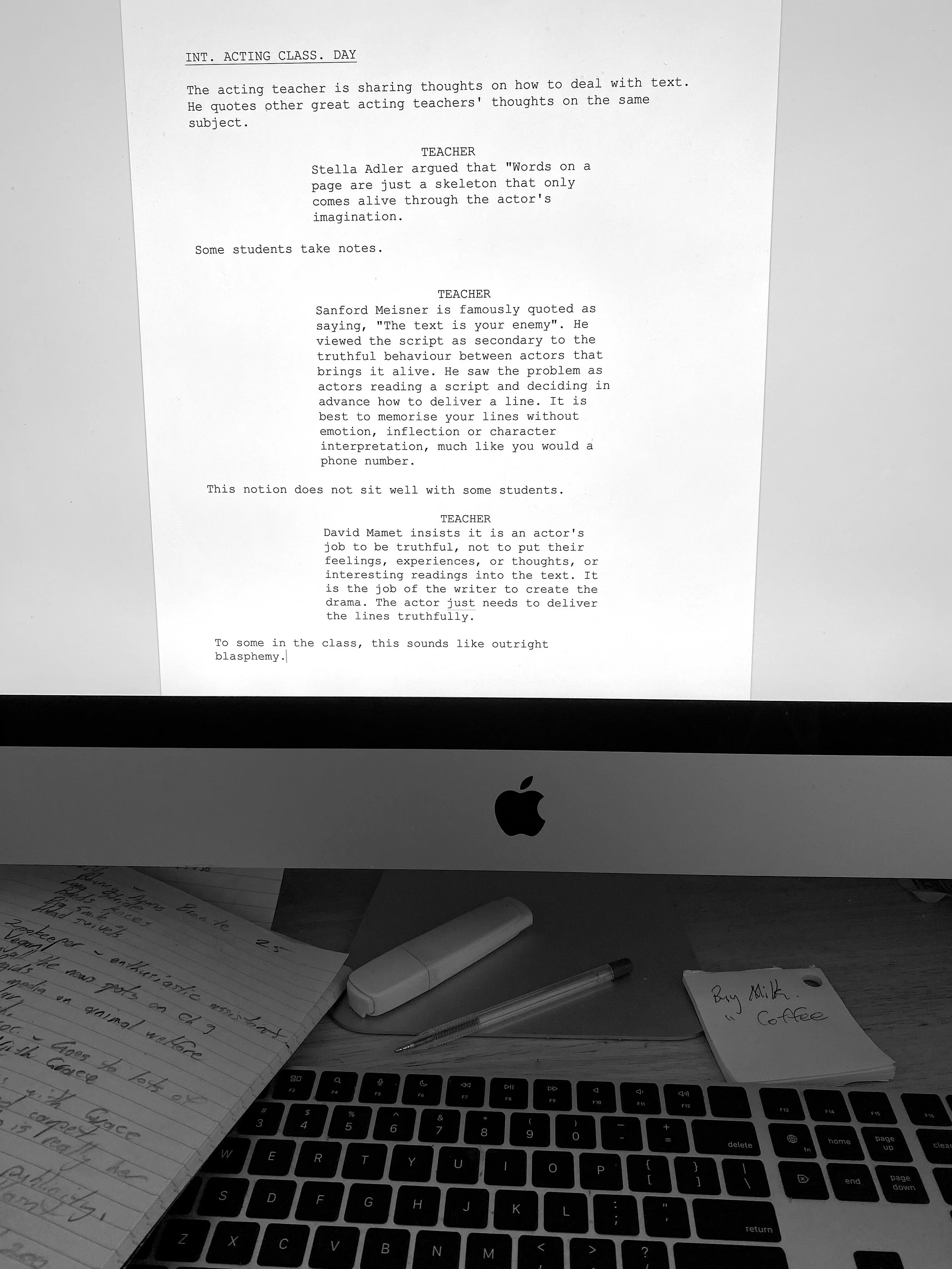
Playwright, screenwriter and Director David Mamet argues that text and dialogue should never drive a scene; instead, a scene must be driven entirely by a character's urgent, physical objective and the visual progression of the plot. He insists actors deliver the line truthfully, uninflected with emotional backstory, and let the playwright deal with the drama.
Master acting teachers Stella Adler and Sandford Meisner believed that behavior and emotion drive a scene, not text, meaning that the written words on a page are only the tip of the iceberg.
Stella Adler taught that a character's actions and physical objectives generate the emotional life, rather than trying to manufacture a fake feeling just because a script calls for it. The "why" is answered by what you are actively doing to the other person in the room. Sandy Meisner argued that actors must rely on instinctual, moment-to-moment behavior triggered by what your scene partner is actually doing, not by what the script says you should feel.
Many of these themes are re-iterated by some of the greatest filmmakers in history. Alfred Hitchcock believed that silent films were “Pure Cinema”. He said that “To me, one of the cardinal sins for a scriptwriter, when he runs into some difficulty, is to say, we can cover that by a line of dialogue. Dialogue should simply be a sound among other sounds, just something that comes out of the mouths of people whose eyes tell the story in visual terms”.
Without dialogue exposition, filmmakers had to communicate inner thoughts, conflicts, and plot arcs entirely through lighting, camera movement, framing, and an actor's physical expression or micro-gestures. A facial expression or physical movement can sometimes communicate far more than a long monologue. Indeed, Mamet in his now legendary memo to the writers of “The Unit” writes “If you pretend the characters can't speak, and write a silent movie, you will be writing great drama”.
Ultimately, acting is doing. True acting isn’t waiting for your turn to say your sentence. It is active listening, where the behavior of your scene partner alters your internal state, as yours does theirs, causing the dialogue to emerge naturally as a byproduct of that interaction.
As Meisner said, text is like a canoe floating on a river. The river is the behaviour and emotions, and the canoe goes where the river takes it.
Artistic Director / Acting Tutor - The Actors Class
